

 29/09/2026 16:03:43
Key Takeaways
Thai Warrior Massage is a modern style built on traditional Thai massage techniques and Ruesi Dat Ton stretching exercises and is generally more physically intensive than a standard session. If you would rather start with a gentler, well-established option, a massage in Chiang Mai at Health Land offers traditional Thai technique in a calmer, more relaxation-focused format.
For people who regularly get massages, a typical session may no longer be firm enough for their liking. If this sounds like you, it may be time for you to consider a Thai Warrior Massage.
The Thai Warrior Massage is a more dynamic, modern variation built on traditional Thai massage techniques, combined with deeper assisted stretching and flowing body movements. Although some proponents promote it as a rediscovered ancient practice, experts typically attribute its modern iteration to a Thai massage instructor who recently developed and popularized it, combining traditional methods with Ruesi Dat Ton (Thai hermit stretching).
This guide explains what the style involves, how it compares with traditional Thai massage, and what to expect if you try it for the first time.
At its core, Thai Warrior Massage builds on the foundations of traditional Thai massage, adding deeper stretches, rhythmic movements, and more dynamic body positioning. It draws on Ruesi Dat Ton, a set of traditional Thai stretching exercises sometimes described as a form of self-massage or yoga. This approach creates a style for energetic people, office workers with stiffness, and travelers needing recovery from long trips, offering a more intense and involved session than usual relaxation massages.
This technique targets the legs, hips, shoulders, and back, focusing more on areas prone to tension like the calves and lower back after prolonged standing or sitting.
Because the stretching is more active than in a standard Thai massage, therapists often work through a wider range of motion at each joint.
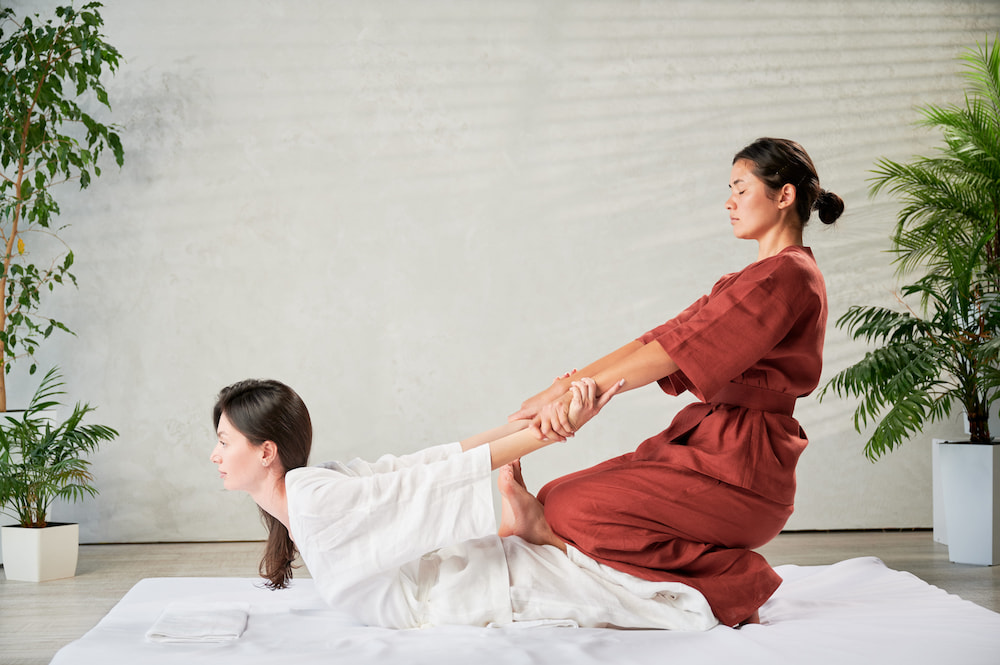
It is said that the Thai Warrior Massage was a centuries-old practice once used to treat warriors returning from battle. Some accounts described that the practice was later banned under the Rama VI era (1880 to 1925) as it was seen as "primitive" and unsuitable as Siam began to modernize.
During this time, teaching was said to have continued only in private until King Bhumibol Adulyadej (1950 to 2016) declared support for all Thai holistic traditional medicine and massage approaches.
Other records suggest a more recent origin, with the current style developed and popularized in the last twenty years by Pathompon Aiyarattanaruk (aka Jack Sharman), who based it on traditional Thai massage and Ruesi Dat Ton stretching.
| Traditional Thai Massage | Thai Warrior Massage | |
| Foundation | Acupressure and assisted stretching along the body's Sen lines, a traditional framework rather than a proven anatomical structure | Builds on traditional Thai massage technique with added stretching influence from Ruesi Dat Ton |
| Pressure | Generally moderate and relaxation-focused | Stronger pressure and more active stretching |
| Movement style | Slower, steadier rhythm | Larger, flowing movements and more dynamic positioning |
| Overall feel | Suited to overall wellness and relaxation | Can feel more physically intensive while still supporting relaxation and mobility |
Most people find that any soreness settles within a day or two, similar to how muscles feel after a firm workout. Light activity such as walking tends to help more than sitting still, and a warm shower afterward can ease any lingering tightness. If the soreness feels unusually sharp or lasts much longer than a couple of days, schedule a visit with your healthcare professional.
Guests consistently choose traditional Thai massage for a specific reason. A beneficial session improves flexibility, reduces daily aches, and promotes a feeling of comfort within your body. Health Land therapists offer consistent care and focus during each session, tailoring techniques to your comfort rather than using a standardized approach.
Book your massage in Chiang Mai at Health Land. Walk-ins are welcome, and online reservations are available daily from 9:00 a.m. to 11:00 p.m.
References:
Q: What is Thai Warrior Massage?
A: It is a modern style built on traditional Thai massage technique, combined with deeper assisted stretching and Ruesi Dat Ton stretching exercises, generally more physically intensive than a standard session.
Q: How is it different from traditional Thai massage?
A: Traditional Thai massage generally follows a slower, more relaxing rhythm, while Thai Warrior Massage uses stronger pressure and larger, more dynamic stretching movements.
Q: What should I expect during my first session?
A: Expect a brief consultation, loose comfortable clothing, and a combination of firm acupressure and assisted stretching. Mild soreness afterward can be normal.
Q: Who is Thai Warrior Massage best suited for?
A: It tends to suit people who already have some experience with massage or bodywork and want a firmer, more active session rather than a gentle introduction.
Q: What is Thai Warrior Massage, and how is it different from traditional Thai massage?
A: Thai Warrior Massage is a modern style built on traditional Thai massage technique, using stronger pressure and larger, more dynamic stretching movements, while traditional Thai massage follows a slower, more relaxing rhythm.
Q: Thai Warrior Massage: what should you expect the first time?
A: Expect a short consultation, loose comfortable clothing, and a combination of firm acupressure and assisted stretching, with mild soreness afterward being normal.




Share With :